

 Inicio
  Home
Home 
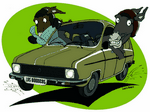
"This is a genuinely dangerous thing to do... you cannot underestimate the risks involved in undertaking this kind of journey. Your chance of dying is very high. Medical facilities are often very poor and road safety standards are appalling. Some past teams have been involved in road accidents and your chance of survival is very low if you are involved in anything but very minor accidents. Temperatures and humidity alone can cause serious illness or death, not to mention altitude sickness. You really are on your own. If it all goes, wrong, that's it, tough. In short, do not undertake this lightly." The Adventurists, Charity Mongol Rally promoters.

Go to Accident Insurance
Go to information about Vaccines and countries
VISAS and entry requirements
| Country | Requires Visa |
Costs in Euros |
Cost for application processed by an agency |
Number of days for processin (in Spain) |
| Spain | No | 0 | 0 | - |
| France | No | 0 | 0 | - |
| Switzerland | No | 0 | 0 | - |
| Czech Republic | No | 0 | 0 | - |
| Polonia | No | 0 | 0 | - |
| Slovaquia | No | 0 | 0 | - |
| Ucrania | No | 0 | 0 | - |
| Hungary | No | 0 | 0 | - |
| Rumania | No | 0 | 0 | - |
| Bulgary | No | 0 | 0 | - |
| Turkey | No | 0 | 0 | - |
| Georgia | No | 0 | 0 | - |
| Armenia | Sí | 61 | 34,59 | 10 |
| Iran | Sí | 60 | 34,59 | 20 |
| Azerbayan | Sí | 80 | 34,59 | 7 |
| Turkmenistan | Sí | 60 | 96,16 | 14 |
| Uzbequistán | Sí | 80 | 96,16 | 15 |
| Kyrgyzstan | Sí | 35 | 34,59 | 15 |
| Kazahkhstan | Sí | 23 | 34,59 | 15 |
| China | Sí | 35 | 34,59 | 8 |
| Russia | Sí | 35 | 34,59 | 10 |
| Mongolia | Sí | 50 | 34,59 | 10 |
| Total | 6 visados | 303,0 eur | 268,48 eur + IVA |
In red the VISAS we need for our route.
Dates for our Visas
Country |
From |
To |
| Azerbaijan | 25th July | 24th August |
| Kazakhstan | 28th July | 27th August |
| Uzbekistan | 29th July | 28th August |
| Kirghizstan | 3rd August | 2nd september |
| Russia | 10th August | 9th september |
Mongolia |
12th August |
11th september |
Entry requirements
Azerbayan
Georgia
Russia
Uzbekistan
Kazahkhstan
Kyrgyzstan
Mongolia
Azerbayan
Visas
British nationals require a visa for Azerbaijan. Single and multiple entry visas can be obtained from: Embassy of the Republic of Azerbaijan, 4 Kensington Court, London W8 5DL; tel: 020 7938 3412; fax: 020 7937 1783; e-mail: sefir@btinternet.com. Alternatively, if arriving by air at Baku, you can obtain a transit or single entry visa (up to 30 days) on arrival.
The Azerbaijan Ministry for Foreign Affairs have stated that the new fees for single entry visas will match the fee charged for a UK six-Month Multiple Entry Visa - £63.00 (AZN 111). The fee can be paid in US dollars and Azerbaijani manats. You are advised to carry a sufficient amount of either currency to cover the cost of a visa. There are cash machines at the airport but these may not always work. In addition to the fee you should present two passport-sized photographs. A letter of invitation is also requested.
Please ensure to check the duration of your visa as soon as it is given to avoid unintentional illegal overstaying and problems with Immigration at the airport on leaving Azerbaijan.
Your visa should be valid when departing Azerbaijan. Extensions can be obtained at the Ministry for Foreign Affairs in Baku, 4 ShikhaliGurban Street, Baku (telephone 492 8383). An exit visa, which you would require if your visa has expired, costs AZN 111. You may also be liable for a fine for overstaying.
Passport validity
Passport should be valid for at least six months from the date of entry into Azerbaijan.
Caspian Sea ferry services
If you intend to take one of the Caspian Sea ferry services from Azerbaijan to Turkmenistan or Kazakhstan you should be aware that you need a valid visa for that country before you travel. You may find that if you arrive at your destination without a valid visa you will be returned back to Azerbaijan. Please note that there is no Embassy of Turkmenistan in Baku. Visas for Turkmenistan should be obtained before arriving in Azerbaijan.
Staying for longer than 30 days
All foreign nationals staying in Azerbaijan for longer than 30 days are required to carry an official ID card. This can be obtained from the police station nearest to your residence. We advise you to carry a photocopy of your passport details page and existing Azerbaijan visa while your application for a new or renewed visa or ID card is being processed. This can take between 1-2 weeks. Ministry of Interior Police have conducted random checks of expatriates since mid-February 2007, and have detained some who were not carrying valid ID cards in accordance with the law.
Travelling with children
Single parents or other adults travelling alone with children should be aware that some countries require documentary evidence of parental responsibility before allowing lone parents to enter the country or, in some cases, before permitting the children to leave the country.
Health
Medical facilities outside Baku are very limited. Serious illness or injury may require evacuation to, Turkey or Western Europe. You should therefore ensure that your insurance covers this.
There have been outbreaks of rabies in the remote rural areas of Azerbaijan and there is usually a small number of malaria cases during the summer months particularly in the southern part of Azerbaijan.
You should not drink tap water as it may be unsafe but safe bottled water is readily available.
You should be aware that contaminated locally produced alcoholic spirits are sometimes sold in small local bars and restaurants.
In the 2006 Report on the Global AIDS Epidemic the UNAIDS/WHO Working Group estimated that around 5,400 adults aged 15 or over in Azerbaijan were living with HIV; the prevalence rate was estimated at around 0.1% of the adult population. This compares to the prevalence rate in adults in the UK of around 0.2%. You should exercise normal precautions to avoid exposure to HIV/AIDS. For more general information on how to do this see HIV and AIDS.
You should seek medical advice before travelling to Azerbaijan and ensure that all appropriate vaccinations are up-to-date. For further information on vaccination requirements, health outbreaks and general disease protection and prevention you should visit the websites of the NaTHNaC and NHS Scotland’s Fit for Travel or call NHS Direct on 0845 46 47.
Avian Influenza (Bird Flu)
Outbreaks of Avian Influenza (Bird Flu) occurred in various regions of Azerbaijan in early 2006, resulting in five human fatalities in the Salyan and Tartar Region. Since the end of 2003, a number of human deaths have also occurred in Cambodia, China, Egypt, Indonesia, Iraq, Laos, Nigeria, Pakistan, Thailand, Turkey and Vietnam.
The risk to humans from Avian Influenza is believed to be very low. However, as a precaution, you should avoid visiting live animal markets, poultry farms and other places where you may come into close contact with domestic, caged or wild birds; and ensure poultry and egg dishes are thoroughly cooked.
The World Health Organisation (WHO) has warned of the possibility that the Avian Influenza outbreaks could lead at some point to a human flu pandemic, if the virus mutates to a form which is easily transmissible between people.
British nationals living longer term in an Avian-Influenza affected region should take personal responsibility for their own safety in the event of a future pandemic, including considering their access to adequate healthcare and ensuring travel documents are up to date.
Natural Disasters
The Caucasus is an area of regular seismic activity, although there have been no recent serious earthquakes in Azerbaijan.
General Insurance
You are strongly advised to obtain comprehensive medical as well as travel insurance to cover illness, injury and loss of money, baggage and tickets before travelling. You should check any exclusions, and that your policy covers you for all the activities you want to undertake. Serious illness or injury may require evacuation to Turkey or Western Europe so you should ensure that your insurance covers this. For more general informaton see Travel Insurance.
If things do go wrong when you are overseas then this is How We Can Help.
Registering with the British Embassy
Register with our LOCATE service to tell us when and where you are travelling abroad or where you live abroad so our consular and crisis staff can provide better assistance to you in an emergency. More information about registering with LOCATE can be found here.
Consular Assistance
Around 5,000 – 7,000 British nationals visit Azerbaijan every year, mainly on business. The Embassy provides a full consular protection service, including issuing passports, registering births and deaths and certain notarial acts. The Embassy also assists British Citizens in distress, including those in detention. The main types of incidents for which British nationals require consular assistance in Azerbaijan is for passport renewals.
Money
All goods and services should be paid for in local currency (Manats). However, US Dollars and the Euro are widely used. Sterling, US Dollars and Euros can easily be exchanged for the local currency. Major hotels and international supermarkets and restaurants accept credit cards. You are advised not to carry large amounts of cash. ATMscan be found in most major towns and cities.
Entry requirements
Visas
As a British National you may enter Georgia for up to 90 days without a visa. You may extend your stay in Georgia beyond 90 days by applying for a temporary or permanent residence permit from the Civil Registration Agency of the Ministry of Justice of Georgia. Georgian law provides for the immediate deportation of anyone who overstays without a valid permit, together with a ban on re-entering Georgian territory for up to one year.
Transiting Georgia or other Commonwealth of Independent States (CIS) countries
The 1992 agreement allowing visas issued for one Commonwealth of Independent States (CIS) country to be used to transit another CIS country is still valid for diplomatic passport holders, although not all CIS countries have signed this agreement. However, ordinary passport holders should obtain visas for all countries to be visited. If you are planning to visit two or more CIS countries, you should contact the relevant embassies in London for advice before travelling.
Travelling with children
If you travel to or in Georgia with a child other than your own, you must be able to be able to demonstrate that you have the consent of the child’s parents or guardians.
Health
Medical facilities in Tbilisi are available but can be expensive. Outside of Tbilisi, medical facilities are limited.
There continues to be outbreaks of rabies in Georgia. Tap water should be avoided. Bottled water is widely available.
You should seek medical advice before travelling and ensure that all appropriate vaccinations are up-to-date. NHS Direct (0845 46 47) can provide you with advice on the vaccination requirements for Georgia.
For further information on endemic diseases, like malaria, health outbreaks and vaccination requirements for Georgia you should check the websites of the National Travel Health Network and Centre NaTHNaC and NHS Scotland's Fit For Travel.
Avian Influenza (Bird Flu)
The World Health Organisation (WHO) has confirmed that there have been outbreaks of Avian Influenza (Bird Flu) in wild swans in the Adjara region of Georgia, 300km from Tbilisi. No human infections or deaths have been reported.
The risk to humans from Avian Influenza is believed to be very low. As a precaution, you should avoid visiting live animal markets, poultry farms and other places where you may come into close contact with domestic, caged or wild birds; and ensure poultry and egg dishes are thoroughly cooked.
You should read this advice in conjunction with the {InternalLink:7}, which gives more detailed information.
NATURAL DISASTERS
Georgia is situated in an area of seismic activity. The last earthquake in Tbilisi was in April 2002.
Entry requirements
Visas
Visas are required to enter Russia. During periods of high demand, for example during the summer holidays, you should apply for your visa well in advance. If you live in England, Wales or Northern Ireland you should apply to the Russian Embassy in London: http://www.great-britain.mid.ru. If you live in Scotland, you should apply to the Russian Consulate General in Edinburgh.
The Embassy in London can normally process visas in 15 working days, and you can submit an application by post or in person. If you want to get a visa more quickly it is possible to queue in person and pay an extra fee, though the numbers processed in this way per day are limited. You must have an exit visa to leave Russia. Most entry visas include an exit visa. However, some entry visas including certain types of student visas, do not include an exit visa. If this is the case your sponsor, not the Embassy or Consulates, will need to obtain the exit visa for you before you can leave the country. Before you travel to Russia ensure that you are aware of the terms and conditions attached to your visa and check that the dates and details which have been entered on your visa are correct. Presenting documentation which contains incorrect information to immigration officials can lead to severe inconvenience and in some cases could result in refusal of entry.
For stays of more than three days
You must register your visa within three working days of arrival in Russia with the local branch of the Ministry of Internal Affairs. Most major hotels will do this automatically. If you are staying in private accommodation the owner of the property must do this for you. You need not register a visa if your visit is for under three days.
Passport validity
If your passport has less than six months to run, you may be refused entry to Russia. You are advised to get a replacement passport before travelling.
Migration Cards
All foreign nationals entering Russia must fill in a migration card. The card is in two identical parts. One part will be retained by the Immigration Officer on arrival. You should keep the other part with your passport and show it, along with your passport, to the police, if they stop you for an identity check during your stay. You should hand in the second part to the Immigration Officer on your departure from Russia. You must complete a new migration card each time you enter Russia, even if you have a multiple entry visa. If you lose the second part of the card you will be fined, and your departure from the country could be delayed.
Travelling with children
Single parents or other adults travelling alone with children should be aware that some countries require documentary evidence of parental responsibility before allowing lone parents to enter the country or, in some cases, before permitting the children to leave the country. For further information on exactly what will be required at immigration please contact the Russian Embassy in London http://www.great-britain.mid.ru.
Parents should note that children born overseas and added to their Russian passports by Russian Embassies may now have to obtain their own passport to exit Russia. There have been instances where a parent has renewed their own passport but the authorities have refused to add the child to it until the child's claim to Russian citizenship is properly substantiated. Parents should check the Russian Nationality Act and contact their nearest Russian Embassy or Consulate to ensure that their child has a claim to Russian citizenship, and that they have the necessary paperwork to prove this before travelling to Russia to renew passports.
Transit through Belarus
If you intend to travel by train on popular routes such as Warsaw-Moscow or St Petersburg-Kiev you will need to obtain a transit visa for Belarus before travelling.
Dual Nationality
Under international law, the British Embassy or Consulates cannot formally intervene with the Russian authorities on behalf of dual Russian/British citizens who encounter difficulties whilst in Russia.
If you come to Russia to renew your Russian international passport, you should be aware that it may take up to four months for a new passport to be issued. You will have to remain in Russia throughout this period. If this happens, the British Embassy or Consulates cannot obtain an exit visa for your British passport.
Customs
You may import into the country up to 3,000 US dollars (or equivalent) without declaring it. You may export from the country up to 3,000 US dollars without declaring it. If you export from the country currency or travellers cheques worth between 3,000 and 10,000 US dollars, it must be declared on departure. Since 31 July 2005, a limit of the equivalent of 10,000 dollars has been set on the amount of roubles and foreign currency that can be taken out of or brought into Russia.
If you import into the country a sum of money between 3,000 and 10,000 US dollars or certain categories of goods such as more costly electrical items, jewellery or antiques and valuable musical instruments you must complete a customs declaration form (available at all ports of entry) on arrival.
If you wish to import certain sophisticated electronic items (e.g. Global Positioning System instruments), you must get an operating licence from the Russian authorities before you travel. If you are unsure whether you should declare an item or need an operating license you should check with the Embassy of the Russian Federation: http://www.great-britain.mid.ru before your departure.
If you complete a declaration form you must ensure that it is stamped by a Customs official at your port of entry or it will not be valid. If you fail to complete a declaration form on arrival or to get it validated by Customs officials your foreign currency and non-declared items may be confiscated when you leave Russia and you may be fined.
There are also strict regulations governing the export from Russia of antiques, icons, medals, artwork and other items of historical significance. This includes modern art and even posters if they are particularly rare or valuable. If you wish to export such material from Russia, you must receive approval from the Ministry of Culture. This may be requested at the point of departure. Infringements of these regulations are treated seriously and may result in imprisonment.
Health
A Reciprocal Health Care Agreement operates between the UK and Russia. This entitles British nationals to free treatment in a Russian hospital. However, any treatment you receive is likely to be limited.
Food poisoning, tuberculosis and rabies are prevalent throughout Russia. There is also a risk of tick-borne encephalitis in rural and wooded areas. Incidences of infection with HIV continue to increase and the Chief Public Health Officer announced that there are 370,000 officially registered cases in Russia. Tap water is not drinkable anywhere in Russia. Caution should be exercised and local advice sought. Bottled mineral water is widely available.
You should seek medical advice before travelling and ensure that all appropriate vaccinations are up to date. NHS Direct (0845 46 47) can provide you advice on vaccination requirements for Russia.
For further information on endemic diseases, like malaria, health outbreaks and vaccination requirements for Russia you should check the websites of NaTHNaC and NHS Scotland's Fit For Travel
Avian Influenza (Bird Flu)
In December 2007 an outbreak of H5N1 avian influenza in chickens on a farm in Rostovskaya province was reported to the World Organisation for Animal Health. In mid-February 2007 the Russian authorities confirmed a number of outbreaks of the H5N1 strain of avian influenza in the area around Moscow. The virus has currently only been found in household flocks, and no cases have been reported on commercial farms. The Russian authorities have taken action to control the outbreak, and have placed several areas under quarantine. At present we have no evidence that the outbreaks pose a risk to humans.
In 2005 there were reports of outbreaks of avian influenza in a number of other regions in Russia, including Tula, Tambov, Kurgan, Chelyabinsk, Novosibirsk and Krasnodar. The European Union has banned imports of live birds and feathers from Russia (with the exception of Kaliningrad and some areas adjacent to the Finnish Border) as a precautionary measure. No human infections or deaths have been reported.
The risk to humans from avian influenza is believed to be very low. As a precaution, you should avoid visiting live animal markets, poultry farms and other places where you may come into close contact with domestic, caged or wild birds; and ensure poultry and egg dishes are thoroughly cooked.
NATURAL DISASTERS
There are occasional occurrences of flooding in Russia, mainly in Siberia, and also earthquakes in the North Caucasus and in the Far Eastern region.
General Insurance
We strongly recommend that you obtain comprehensive travel and medical insurance before travelling. You should check any exclusions, and that your policy covers you for any activities you may wish to undertake. As well as full insurance cover for medical treatment and accidents, we recommend that you obtain cover for unexpected losses such as cancelled flights, stolen cash, cards, passport or luggage.
Registering your presence
We advise all British visitors and residents, particularly those visiting remote parts of Russia, to register with the Consular Sections of the British Embassy, Moscow or the British Consulates-General in Ekaterinburg and St Petersburg. The contact details of the Consulates-General can be accessed by following the hyperlink “UK Overseas Mission: Russian Federation” below.
Entry requirements
Visas
British nationals need a visa to enter Uzbekistan, which you should get before you travel. If you plan to travel to neighbouring countries from Uzbekistan, you should also get your visa in advance, rather than trying to obtain it at the border. http://www.uzbekembassy.org/
You should obtain a visa to cover your entire stay before you arrive. You will need to provide a letter of invitation with your application. Business visitors must get one from an Uzbek business partner whilst tourists must get it from the tour company arranging the visit. Do not try to cross the border illegally as the absence of entry/exit stamps will cause problems (e.g. possible detention, fines) when you try to leave or re-enter. Do not overstay your visa and ensure you have onward visas for other countries if travelling elsewhere. It is not always easy or possible to extend your visa if you wish to remain in the country for longer than you had originally intended.
Registering your presence
You should register within three days of arrival. If you are staying in a hotel, they will ask you for your passport at check in and retain it for a short period, they will complete the registration paperwork and return your passport to you. If you are staying in a private house, your host should register you with their local district OVIR (Department of Foreign Travel & Exit (they also deal with the registration of Foreign Citizens). If you travel to another city and plan to stay for longer than three days, you will need to register again.
Travelling to other countries from Uzbekistan
You should ensure that you have a valid visa for the next country you intend to visitor transit. We are aware of a number of people have been sent back to Uzbekistan for failing to do this. Please note that if you intend to travel to Kazakhstan you also need to have a valid visa to visit, or transit, Kyrgyzstan.
Travelling with children
Single parents or other adults travelling alone with children should be aware that some countries require documentary evidence of parental responsibility before allowing lone parents to enter the country or, in some cases, before permitting the children to leave the country. For further information on exactly what will be required at immigration please contact http://www.uzbekembassy.org/
Health
Hospitals look basic by UK standards, however basic healthcare is adequate. Medical insurance companies usually refer complaints of a more serious nature to hospitals in Europe or New Delhi.
Outbreaks of Hepatitis A, Meningitis and Diphtheria have occurred in Uzbekistan. There have also been confirmed cases of malaria contracted in the southern Sukhandarya province.
You should drink only bottled water.
You should seek medical advice before travelling and ensure that all appropriate vaccinations are up to date. NHS Direct (0845 46 47) can provide you with advice on the vaccination requirements for Uzbekistan.
For further information on endemic diseases, like malaria, health outbreaks and vaccination requirements for Uzbekistan you should check the websites of NaTHNaC and NHS Scotland’s Fit for Travel.
NATURAL DISASTERS
Uzbekistan is located in an active seismic zone. The last significant earthquake to cause major damage in Uzbekistan was in 1966.
GeneralInsurance
We strongly recommend that you obtain comprehensive travel and medical insurance before travelling to Uzbekistan. You should check any exclusions, and that your policy covers you for all the activities you want to undertake.
Next of kin details
You should ensure that your next of kin details are entered into the back of your passport. Make a copy of your passport and driving licence and store these separately from the originals.
Registration
You should register with the Embassy even if you are only a short term visitor and inform the Embassy of any changes to your itinerary. You could register online at www.britain.uz
ID
It is advisable to carry a photocopy of your passport at all times. Requests to produce proof of identity, for example by the police, are frequent.
Entry requirements
Visas
All British passport holders must have a valid visa prior to travel. A visa for Kazakhstan is normally valid for 30 days from the date of issue and should be obtained from your nearest Kazakhstan Embassy before travelling: (Embassy of the Republic of Kazakhstan, 33 Thurlowe Square, London, SW7 2DS, Tel: 020 7581 4646, Fax: 020 7584 8481, website: http://www.kazakhstanembassy.org.uk) There is also a Consulate based in Aberdeen that can issue visas.
Passport validity
You should ensure that your passport is valid for at least three months after your proposed date of leaving Kazakhstan.
Visits of up to 30 days
British Passport holders travelling to Kazakhstan do not need to register with the local authorities (OVIR –The Department for Visas and Registration under the Ministry of Internal Affairs (MIA)) providing you arrive at one of the 12 Kazakhstan International Airports and you do not intend to stay for longer than 30 days.
For journeys less than 30 days, British Passport Holders MUST ensure that they keep their white Immigration Card stamped by Kazakhstani Immigration throughout their journey and ready for inspection upon departure. Failure to do so could result in you having to register with the local authorities. If you intend to travel through any of Kazakhstan’s border points you should check with the nearest Kazakhstan Embassy to see whether registration with OVIR is required.
Visits for more than 30 days and long-term visitors
If you intend staying for longer than 30 days you will need to register with the local authorities. In such circumstances you may be registered through the organisation that invited you to Kazakhstan or the tourist agency organising your visit. As your registration includes details of where you work or study and your residence in Kazakhstan the MIA should be informed in writing of any changes to these details.
For long-term visitors (including Work Permit holders), you should bring with you an original HIV/Aids-free certificate as this is needed for the local authorities where you live/work. You should ensure you have the original with you, as copies are not accepted.
Caspian Sea ferry services
If you intend to take one of the Caspian Sea ferry services from Kazakhstan to Azerbaijan you should be aware that you need a valid visa for that country before you travel. You may find that if you arrive at your destination without a valid visa you will be returned back to Kazakhstan.
Transiting Kazakhstan
There is no agreement allowing visas issued in one Commonwealth of Independent States (CIS) country to be used to transit Kazakhstan. If you intend to visit two or more CIS countries you should contact the relevant embassies for advice before travelling.
Travelling with children
Single parents or other adults travelling alone with children should be aware that some countries require documentary evidence of parental responsibility before allowing lone parents to enter the country or, in some cases, before permitting the children to leave the country.
Health
The local medical facilities are not as advanced as those in the UK. You should ensure that your medical insurance includes evacuation by air ambulance.
Cases of tuberculosis have been reported in the Aral Sea and Semipalatinsk regions, as well as in prisons.
There are over 6,000 HIV-infections recorded in Kazakhstan.
There have been occasional outbreaks of haemorrhagic fever with renal syndrome in southern Kazakhstan, most recently in June 2006. In rural areas there are occasional cases of brucellosis picked up from infected meat.
Tics carrying encephalitis are also a problem in mountains and forests, particularly during from April to June. Vaccination is available but we advise that you keep all areas of your body covered when close to shrubs or bushes, and to inspect yourself regularly for tics.
You should seek medical advice before travelling and ensure that all appropriate vaccinations are up to date. NHS Direct (0845 46 47) can provide you with advice on the vaccination requirements for Kazakhstan.
For further information on endemic diseases, health outbreaks and vaccination requirements for Kazakhstan you should check the websites of NaTHNaC and NHS Scotland's Fit For Travel.
Avian Influenza (Bird Flu)
There were reports of outbreaks of bird flu around Northern Kazakhstan in July and August 2005 and in the Caspian Sea region in January 2006. The Kazakh authorities believe that the situation is now under control and preventive measures are in place. No human infections or deaths have been reported.
The risk to humans from Avian Influenza is believed to be very low. As a precaution, you should avoid visiting live animal markets, poultry farms and other places where you may come into close contact with domestic, caged or wild birds; and ensure poultry and egg dishes are thoroughly cooked.
NATURAL DISASTERS
Almaty is in an active seismic zone. But the last major earthquake involving loss of life was in 1927.
GeneralInsurance
We strongly recommend that you have comprehensive travel and medical insurance before travelling. If you are planning an adventure holiday (including skiing or climbing in the mountains near Almaty) you must ensure that your medical insurance includes air ambulance evacuation. You should check any exclusions, and that your policy covers you for all the activities you want to undertake.
Registering with the British Embassy
If you are staying longer than a couple of weeks, or intend to go off the beaten track, you should register with the Embassy on arrival. You can register with the British Embassy online through www.fco.gov.uk - online consular registration services.
Replacing a lost or stolen passport
If you lose your passport you must report this immediately to the police and obtain a police report.
The British Embassy Office, 97 Zholdasbekova street Samal Towers, 9th Floor (Tel: (00 7 3272 506191) does not issue full passports and, before setting off, you should ensure that your passport has sufficient validity and a good number of unused pages. However the Embassy is able to accept applications for new passports, which will be forwarded to the British Embassy in Moscow for processing. Please be aware that this may take between 4-6 weeks. Temporary passports, valid for one year, are available in Almaty and can usually be produced within 24 hours. You should ensure that you have entered your next of kin details into the back of your passport.
Health
Medical facilities are not as developed as those in the UK.
Tuberculosis is widespread throughout the country (706 deaths in 2005) and there are regular outbreaks of Hepatitis A, meningitis and brucellosis. Cases of AIDS (22 deaths in 2005) and malaria (100 cases registered in the first half of 2006, mainly in the outskirts of Bishkek) have also been registered.
You should seek medical advice before travelling and ensure that all appropriate vaccinations are up to date. NHS Direct (0845 46 47) can provide you advice on vaccination requirements for Kyrgyzstan. www.dh.gov.uk
For further information on endemic diseases, health outbreaks and vaccination requirements for Kyrgyzstan you should check the websites NaTHNaC and NHS Scotland's Fit For Travel
Avian Influenza (Bird Flu)
There have been no reported cases of Avian Influenza (also known as Bird Flu) in Kyrgystan. But the World Health Organisation (WHO) has confirmed cases elsewhere in the region.
NATURAL DISASTERS
Kyrgyzstan is located in an active seismic zone. Avalanches and landslides frequently block roads in the spring. There have been a number of tremors in recent months – the strongest of which measured 6 on the Richter Scale on 8 January 2007.
GeneralInsurance
We strongly recommend that you obtain comprehensive travel and medical insurance, including evacuation by air ambulance, before travelling. This advice is particularly relevant if planning an adventure holiday (e.g. skiing, mountaineering etc…). You should check any exclusions, and that your policy covers you forn all the activities you want to undertake.
British representation
British interests in Kyrgyzstan are represented overall by the British Embassy in Astana, Kazakhstan. However, consular or emergency cover for Kyrgyzstan will be provided by the British Embassy Office in Almaty, Kazakhstan. For consular advice or emergency assistance, please contact the British Honorary Consul in Bishkek, who works closely with the British Embassy Office in Almaty.
Passport
You should carry your passport, or a notarised copy of it, at all times. The police can arrest you if you do not carry identification.
The British Embassy Office in Almaty does not issue passports and, before setting off, you should ensure that your passport has sufficient validity and a good number of unused pages. However, the Embassy Office is able to accept applications for new passports, which will be forwarded to the British Embassy in Moscow for processing. Please note that this may take up to four weeks. Temporary passports, valid for one year, are available in Almaty and can usually be produced within 24 hours.
Entry requirements
Visas
All British passport holders must have a Mongolian visa. A Mongolian visa (for up to 30 days stay) is normally valid for six months from the date of issue and should be obtained from your nearest Mongolian Embassy before travelling. Your passport must be valid for more than six months after the date you intend to enter Mongolia.
British passport holders need visas to enter China and Russia. Many travellers have reported considerable difficulties in obtaining Russian visas in Ulaanbaatar. We advise you to obtain all necessary visas for your onward travel before entering Mongolia. British passport holders may transit China without a visa provided they are in transit for less than 24 hours and do not leave the transit area. However, not all airlines offer a transit facility and your transfer may therefore involve retrieving baggage and returning to the check-in hall. Mongolian Airlines are in this category. You should therefore consider obtaining a Chinese visa to smooth your journey. British passport holders may transit Russia without a visa provided the route does not involve changing airports or leaving the transit area.
Passport validity
Your passport must be valid for more than six months after the date you intend to enter Mongolia.
Travelling with children
Adults accompanying children other than their own should have a notarised letter from the legal guardians of the child stating that they are accompanying them.
Registration
You should register your stay in Mongolia with the Foreign Citizen’s Bureau in Ulaanbaatar within your first week of arriving you if intend to remain for more than 30 days, or if you do not have an "Entry/Exit" visa. You must also de-register before leaving Mongolia, at the Foreign Citizens’ Bureau. After de-registering, you must obtain an "Exit" visa from the Consular Department of the Mongolian Ministry of Foreign Affairs. If you do not take these steps, you will not be allowed to leave the country, you may also be fined.
Address for the Office of Immigration, Naturalisation and Foreign Citizens:
11 Chinggis Avenue
Sukhbaatar District
Ulaanbaatar
Tel: 976 11 321704
Fax: 976 11 313259
Email: gihaea@mongolnet.mn
Web-site: www.mnimmigration.mn
Border Crossing
There are only six border points open to British passport holders. They are at Ulaanbaatar’s international airport; the road/train crossing to China at Zamin Uud, the road crossing to China at Tsagaannuur in the far west; the train crossing to Russia at Sukhbaatar and the road crossings to Russia at Altanbulag and Ereen-Tsav in the north east. You cannot cross into China or Russia at any of the other border points, as they that are either seasonal or are only open to Mongolians and/or Chinese/Russians. If you are planning to bring a vehicle into Mongolia at any of these crossings you should inform the tax authorities and border troops in advance.
We are also aware that you may encounter problems when entering Mongolia by train from Russia. These problems are usually with the Russian border or customs officials and are as a result of incorrectly completed Russian customs declarations. If you are crossing at this point, you are strongly advised to you to read the Travel Advice Russia and be scrupulous about correctly completing all possible paperwork when you enter and exit Russia. There can also be lengthy delays (often for several hours) for train passengers travelling across the China/Mongolia border, because of the need to change gauges.
Health
Healthcare facilities in the countryside are very poor. Organising an evacuation to Ulaanbaatar or another country can be extremely difficult and expensive without adequate travel insurance. Even in Ulaanbaatar, only basic healthcare is available. Medicines are scarce in the countryside and you should bring basic supplies, including any regular prescription drugs with you.
Due to the generally poor quality of medical facilities in Mongolia, British Embassy staff are not currently allowed to bring children to live permanently at post, though they can visit on holiday.
Mongolia has occasional outbreaks of Foot and Mouth and other infectious diseases. During these outbreaks affected areas may be quarantined and you may not be able to travel to them. If you are in an affected area, you may not be allowed to leave. During the summer hunting season, there may be isolated cases of bubonic plague, but these are usually confined to the marmot hunters.
You should seek medical advice before travelling and ensure that all appropriate vaccinations are up-to-date. NHS Direct (0845 46 47) can provide you with advice on the vaccination requirements for Mongolia.
For further information on endemic diseases, health outbreaks and vaccination requirements for Mongolia you should check the websites of NaTHNaC and NHS Scotland’s Fit for Travel
Avian Influenza (Bird Flu)
The World Health Organisation (WHO) has confirmed that there have been outbreaks of Avian Influenza (Bird Flu) among migrating birds in Mongolia, most recently in August 2005, in the northern province of Khovsgol. No human infections or deaths have been reported.
The risk to humans from Avian Influenza is believed to be very low. As a precaution you should avoid visiting live animal markets, poultry farms and other places where you may come into close contact with domestic, caged or wild birds; ensure poultry and egg dishes are thoroughly cooked.
General Insurance
We strongly recommend that you obtain comprehensive travel and health insurance before travelling to Mongolia. This should cover the cost of medical treatment, including hospitalisation and evacuation by air ambulance. You should also ensure that your insurance covers unexpected losses or expenses such as lost luggage, stolen cash and credit cards, missed flights, etc. You should check any exclusions, and that your policy covers you for all the activities you want to undertake.
Consular registration
Keep a photocopy of your passport data page and visas as well as numbers of your travellers' cheques safely and separate from your originals. This makes replacement of lost/stolen originals simpler. You should register at the British Embassy, even if you are only staying in Mongolia for a few days and especially if you are travelling into the countryside.
To obtain some visas you need an accident insurance. The following company offers world coverage during to month for not too much euros: 110 aprox. Intermundial Serguro Multiasistencia.
Wordl List (pdf) of recommended vaccines from the Health Ministry of Spain.
Some information about Vaccines (in Spanish)
Se recomienda que todos los viajeros se inmunicen con las vacunas rutinarias apropiadas. Se deben cumplir los plazos de las dosis de recuerdo en los intervalos de tiempo recomendados.
Hepatitis A. Se recomienda la vacunación contra la hepatitis A para todos los viajeros que se desplacen a países en desarrollo y países con economías en transición.
Fiebre amarilla. El hecho de que un país no exija la vacunación obligatoriamente no implica que no exista riesgo de infección por fiebre amarilla. En principio la Organización Mundial de la Salud no incluye ningún país de Europa o Asia dentro de su listado de países con Riesgo de Transición de Fiebre Amarilla.
Cólera. Ningún país exige un certificado de vacunación contra el cólera como condición para la entrada. En el Capítulo 6 se incluye información sobre el uso selectivo de las vacunas contra el cólera.
Viruela. Desde que en 1980 se certificó la erradicación mundial de la viruela, la OMS no recomienda la vacunación contra la viruela para los viajeros.
Los Borricos Team (Madrid, Spain) Sponsors
 |
Mongol Rally Official Sponsors
        |
  |