

 Inicio
  Home
Home 
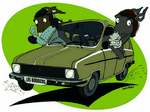
"This is a genuinely dangerous thing to do... you cannot underestimate the risks involved in undertaking this kind of journey. Your chance of dying is very high. Medical facilities are often very poor and road safety standards are appalling. Some past teams have been involved in road accidents and your chance of survival is very low if you are involved in anything but very minor accidents. Temperatures and humidity alone can cause serious illness or death, not to mention altitude sickness. You really are on your own. If it all goes, wrong, that's it, tough. In short, do not undertake this lightly." The Adventurists, Charity Mongol Rally promoters.

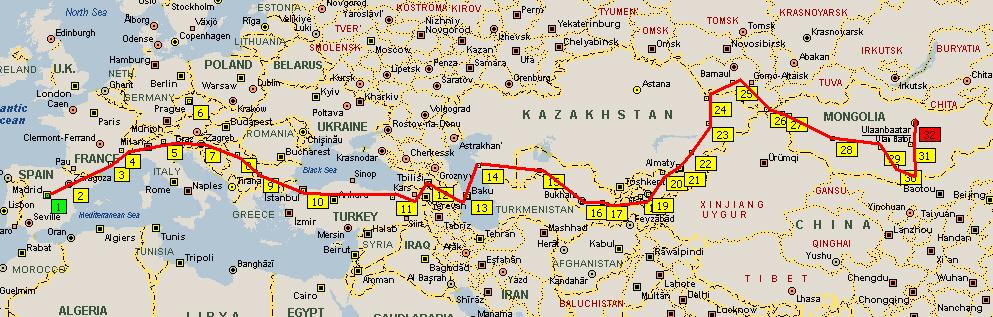
The route to follow is one of the critical points, because most of difficulties and potential problems of the rally depend on the selected distance: geographical accidents, political situation, safety and health, physical conditions of the roads that we must cross and bureaucracy in the borders.
In any case, we do not want to put our personal preferences aside, since we feel like knowing the steppes, deserts, mountains and some cities of Central Asia. We leave the comfort and the simplicity for another occasion.
Our route runs accross Spain, France, Italy, Slovenia, Croatia, Serbia, Bulgary, Turkey, Georgia, Azerbaijan, Kazakhstan, Uzbequistan, Kirghizstan, Kazajstan (again), Russia and Mongolia.
Click on the map to enlarge the image
 |
For coming back maybe some trains (siberian and mongolian), by car or (last option) by plane. See also our page "Visas".
Information of interest for travelling to Mongolia, Russia and Central Asia countries
Azerbayan
Georgia
Russia
Uzbekistan
Kazahkhstan
Kyrgyzstan
Mongolia
You can find more details about our route in the following table. This information is only a forecast
Date |
Day |
Country Entrance |
Original |
Start |
Destiny |
Coming |
|||||
19 th July |
1 |
France |
France |
Madrid |
Perpignan |
20 |
2 |
Italy |
Italia |
Perpignan |
Venice |
21 |
3 |
Serbia |
Република Србија |
Venice |
Belgrado |
22 |
4 |
Turkey |
Türkiye |
Belgrado |
Istambul |
23 |
5 |
|
|
Istambul |
Tokak |
24 |
6 |
|
|
Tokak |
Trabzon |
25 |
7 |
Georgia |
Sakartvelo |
Trabzon |
Tiblisi |
26 |
8 |
Azerbaijan |
Азербайджа́н |
Tiblisi |
Baku |
27 |
9 |
|
|
Baku |
Baku |
28 |
10 |
|
|
Ferry |
Ferry |
29 |
11 |
Kazakhstan |
Казахстан |
Ferry |
Aktau |
30 |
12 |
Uzbekistan |
O‘zbekiston Jumhuriyati |
Aktau |
Nukus |
31 |
13 |
|
|
Nukus |
Bukhara |
1st August |
14 |
|
|
Bukhara |
Samarcanda |
2 |
15 |
|
|
Samarcanda |
Kokand |
3 |
16 |
|
|
Kokand |
Fergana |
4 |
17 |
Kirghizstan |
Киргизия |
Fergana |
Osh |
5 |
18 |
|
|
Osh |
Kara-Köl |
6 |
19 |
|
l |
Kara-köl |
Bishkek |
7 |
20 |
Kazakhstan |
Казахстан |
Bishkek |
Almaty |
8 |
21 |
|
|
Almaty |
Taldy-Kurgan |
9 |
22 |
|
|
Taldy-Kurgan |
Ayaguz |
10 |
23 |
|
|
Ayaguz |
Semipalatinsk (Semey) |
11 |
24 |
Russia |
Россия |
Semipalatinsk |
Barnaul |
12 |
25 |
|
|
Barnaul |
Aktash |
13 |
26 |
Mongolia |
Монгол Улс |
Aktash |
Olgiy |
14 |
27 |
|
|
Olgiy |
Altai |
15 |
28 |
|
|
Altai |
Bayanhongor |
16 |
29 |
|
|
Bayanhongor |
Arvayheer |
17 |
30 |
|
|
Arvayheer |
Dalandzadagad |
18 |
31 |
|
|
Dalandzadagad |
Mandalgobi |
19 |
32 |
|
|
Mandalgobi |
Ulan Bátor |
20 |
33 |
|
|
Ulan Bator |
Ulan Bátor |
Return |
|||||
21 |
34 |
|
Ulan Bátor |
Sühbaatar |
|
22 |
35 |
Russia |
Россия |
Sühbaatar |
Irkutsk |
23 |
36 |
|
Irkutsk |
… |
|
24 |
37 |
|
… |
… |
|
25 |
38 |
|
… |
… |
|
Dates for our Visas
Country |
From |
To |
| Azerbaijan | 25th July | 24th August |
| Kazakhstan | 28th July | 27th August |
| Uzbekistan | 29th July | 28th August |
| Kirghizstan | 3rd August | 2nd september |
| Russia | 10th August | 9th september |
Mongolia |
12th August |
11th september |
Madrid - Istambul - Guide Michelin
Download the best map of Mongolia ever!
Download a guide with useful phrases English-Mongol (Cyrillic)
¡Thanks to Esteban!
   |
Webcams of our route
Puerta del Sol, Madrid | Nacional II (A-2) | Zaragoza | Barcelona | Montepellier, France | Nice | Milan, Italy | Padova | Venice | Slovenia | Croatia | Belgrado, Serbia | Bulgary | Turkey | Gagra, Georgia | Azerbaijan | Kazakhstan | Uzbekistan | Bishkek, Kirghizstan | Kemerovo, Russia | Mongolia
|
|||
|
|||
CET (GMT +1) - Madrid |
EET (GMT +2) -Estambul |
R2T (GMT +3) - Tabriz |
USZ3(GMT +4) - Baku |
USZ4(GMT +5) - Tashkent |
USZ5 (GMT +6) - Almaty |
USZ6 (GMT +7) -Ürünqi |
CCT (GMT +8) - Ulan Bator |
Main figures
| Country | Capital | Altitude | Language | Population | Curreny | Time Zone |
| España | Madrid | 600 m | Español | 44.000.000 | Euro | GMT+1 |
| Francia | París | 40 m | Francés | 60.000.000 | Euro | GMT+1 |
| Suiza | Berna | 520 m | Alemán, francés e italiano | 7.100.000 | Franco suizo | GMT+1 |
| República Checa |
Praga | 250 m | Checo, eslovaco, alemán y ruso | 10.250.000 | Corona | GMT+1 |
| Polonia | Varsovia (Warszawa) | 100 m | Polaco | 38.500.000 | Zloty polaco | GMT+1 |
| Eslovaquia | Bratislava | 130 m | Eslovaco | 5.389.000 | Corona eslovaca | GMT+1 |
| Ucrania | Kiev | 170 m | Ucraniano | 48.000.000 | Moneda Grivna | GMT+2 |
| Hungría | Budapest | 110 m | Húngaro | 9.900.000 | Forint | GMT+1 |
| Rumania | Bucarest | 80 m | Rumano | 22.300.000 | Leu rumano | GMT+2 |
| Bulgaria | Sofía | 570 m | Búlgaro | 7.800.000 | Leva | GMT+2 |
| Turquía | Ankara | 920 m | Turco | 68.000.000 | Libra turca | GMT+2 |
| Georgia | Tiblisi | 400 m | Georgiano | 5.200.000 | Kupon | GMT+3 |
| Armenia | Yereván | 1.000 m | Armenio | 3.400.000 | Dram armenio | GMT+5 |
| Irán | Teherán | 1.150 m | Farsí (Persa) | 72.000.000 | Rial iraní | GMT+3.5 |
| Azerbaián | Bakú | 0 m | Azerí | 8.000.000 | Manat | GMT+5 |
| Turkmenistán | Ashkhabad (Aschabad) | 220 m | Turkmeno | 4.900.000 | Manat | GMT+5 |
| Uzbequistán | Tashkent | 460 m | Uzbeko y ruso | 25.000.000 | Som-kupon | GMT+5 |
| Kirguizistán | Bishkek | 730 m | Kirguiz, ruso y uzbeko | 5.000.000 | Son | GMT+5 |
| Kazajstán | Almaty (Astana) | 356 m | Kazajo | 17.000.000 | Tengue | GMT+5 |
| China | Beijing (Pekín) | 60 m | Chino (común) ó Mandarín | 1.294.000.000 | Yuán | GMT+8 |
| Rusia | Moscú | 160 m | Ruso | 143.000.000 | Rublo Ruso | GMT+2 |
| Mongolia | Ulaanbaatar (Ulan Bator) | 1300 m | Mongol khalkha | 2.500.000 | Tugrik | GMT+8 |
Information of interest for travelling to Mongolia, Russia and Central Asia countries
Azerbayan
Georgia
Russia
Uzbekistan
Kazahkhstan
Kyrgyzstan
Mongolia
Travel Summary
- We advise against all travel to Nagorno-Karabakh and the military occupied area surrounding it.
- Azerbaijan faces a threat from terrorism. Attacks could be indiscriminate and against civilian targets and places frequented by foreigners.
- Outbreaks of Avian Influenza (Bird Flu) in Azerbaijan have led to a small number of human fatalities. The last fatality was in 2006. See the Health (Avian Influenza) section of this advice and Avian and Pandemic Flu for more details.
- You should avoid any political rallies or public gatherings of a political nature.
- The main type of incident for which British nationals required consular assistance in 2007 was replacing lost and stolen passports. Crime against foreigners is generally low, but does occur. See the Crime section of this advice for more details.
- For identification purposes you should carry the correct form of document at all times. See the Local Laws and Customs and Entry Requirements sections of this advice.
- We strongly recommend that you obtain comprehensive travel and medical insurance before travelling. You should check any exclusions, and that your policy covers you for the activities you want to undertake. See the General (Insurance) section of this advice and Travel Insurance for more details.
Safety and security
Terrorism
Azerbaijan faces a threat from terrorism. Attacks could be indiscriminate and against civilian targets, including places frequented by foreigners, such as international hotels, restaurants and pubs, as well as energy sector facilities. You should be aware of these risks and take sensible precautions. For more general information see Terrorism Abroad.
Crime
Visitors to Azerbaijan are generally welcomed. Crime levels in Baku are generally low, but muggings do occur from time to time after dark in the centre of town around the western bars and clubs. Some incidents have also occurred near dimly lit entrances of private apartments.
You should take sensible precautions: be vigilant, avoid showing large sums of money in public and don’t walk alone at night in dark and unlit streets. You should ideally arrange to be picked up or dropped off as close to your hotel or apartment entrance as possible by a reliable driver.
- a private or company driver
- or a taxi and driver known personally to you
- or one accredited to the hotel you are staying in
You should report any crimes to the local police station. Alternatively you can contact the Police Office of Crimes By and Against Foreigners on 490 9532 or 490 9452 out of office hours. When making a report to the Police take someone with you, preferably your company representative or someone who you know and can translate for you. Do not sign any documents you do not understand.
Corruption is an every day aspect of life in Azerbaijan, despite regulations prohibiting corrupt activities by public officials and others. We do not recommend the payment of bribes under any circumstances.
Political Situation
The political situation in Azerbaijan is calm. Presidential elections held in 2003, and parliamentary elections in 2005 and 2006 failed to meet international standards. Presidential elections are due in October 2008.
Demonstrations, both opposition and Government sponsored, occasionally take place in Azerbaijan, and mainly in Baku. Opposition rallies are usually heavily policed and there has been violence on occasions. We recommend that you keep well away from any official or unofficial gathering of a political nature.
Local Travel
We advise against all travel to Nagorno-Karabakh and the military occupied area surrounding it. This area is the subject of a continuing dispute between Azerbaijan and Armenia and although a cease-fire has been in place since 1994 there are regular exchanges of gunfire across the Line of Contact. Some areas may be heavily landmined.
You should not attempt to enter or leave Azerbaijan via the land borders with Russia (i.e. Dagestan) as these are closed to foreign nationals. If you hold a valid visa it is possible to cross the Iranian border at Astara.
Road Travel
You can drive in Azerbaijan using a licence issued by an EU country or by using an International Driving Licence.
Care should be taken when driving in Azerbaijan (particularly at night). Many roads and are of poor quality and are badly lit. Many cars are poorly maintained, and the standard of driving is erratic. Most taxis do not have seat belts.
Drink driving laws are strict and there is a zero limit on drinking alcohol and driving.
Rail Travel
As with other forms of public transport the Baku Metro is poorly maintained, often overcrowded and has inadequate safety and emergency equipment and procedures. Should you travel by train, secure your valuables, do not leave the compartment unattended, and lock the door from the inside.
Air Travel
It is not known whether safety procedures on aircraft used for internal and regional flights meet international standards. You should take this into consideration before using internal or regional flights.
Local laws and customs
Ninety-eight percent of the population of Azerbaijan is Muslim. Azerbaijan is a largely secular society, and religion is usually considered a private matter. You should respect local traditions, customs, laws and religions at all times and be aware of your actions to ensure that they do not offend other cultures or religious beliefs, especially during the holy month of Ramadan or if you intend to visit religious areas. For more general information see.
Local and foreign women usually dress in western-style clothing. However, it is frowned upon for men (and to a certain extent women) to wear shorts, even in the height of summer. This can attract unwelcome attention.
Possession or use of illegal drugs of any kind carries stiff penalties, including fines and long prison terms. The usual penalty for smuggling drugs is a prison term of between three to seven years and/or heavy fines.
Police occasionally carry out checks of identity documents. You are advised to carry your passport at all times, in a secure manner, and to keep a photocopy of the details page separately in a safe place. If you intend to remain in Azerbaijan for more than 30 days you should see the Entry Requirements section (below) for advice on local ID cards.
Homosexual, lesbian and transgender activity is legal in Azerbaijan, but many Azerbaijanis disapprove of public displays of affection.
An export certificate is required to take carpets and anything else considered antique out of Azerbaijan. Export certificates are available from the Carpet Museum or this can be arranged through the seller. It is also important to catalogue and declare to Customs any carpets or anything antique looking – even if clearly from a different part of the world - that you bring to Azerbaijan with you. Your relocation company should be able to offer you advice on this.
You should use common sense when considering photographing sites such as military bases, equipment and installations in whatever condition. These are considered sensitive areas, and visitors have been detained and questioned while attempting to visit them. You should also be aware of cultural sensitivities when photographing mosques, churches and other religious sites. If in doubt, seek permission.
- We advise against all travel to the separatist regions of South Ossetia, Abkhazia and also the upper Kodori Valley (also known as upper Abkhazia). You should also exercise particular caution if you travel to Svaneti, Pankisi valley, Zugdidi and Tsalenjika districts. See the Local Travel section of this advice for more details.
- You should avoid all land borders with the Russian Federation. See the Local Travel section of this advice for more details.
- In the run up to the Parliamentary Elections the Opposition are planning demonstrations, which began on15 February 2008. You should exercise caution and avoid any demonstrations and large crowds. See the Political Situation section of this advice for more details.
- There is an underlying threat from terrorism. Attacks could be indiscriminate, including in places frequented by expatriates and foreign travellers.
- The main type of incident for which British nationals required consular assistance in Georgia in 2007 was for replacing lost and stolen passports. In 2007 four British nationals were arrested in Georgia in alcohol related incidents. Crime against foreigners is generally low, but does occur. See the Crime section of this advice for more details.
- We strongly recommend that you obtain comprehensive travel and medical insurance before travelling. You should check any exclusions, and that your policy covers you for all the activities you want to undertake. See the General (Insurance) section of this advice for more details.
Safety and security
Terrorism
There is an underlying threat from terrorism. Attacks could be indiscriminate, including in places frequented by expatriates and foreign travellers.
Political Situation
Georgia Country Profile
Largely peaceful demonstrations, against the government are ongoing. In the run up to the Parliamentary Elections (to be held on 21 May) the Opposition have declared that they will continue to hold demonstrations.. Whilst these demonstrations are most likely to be in Tbilisi, they may also occur in other major Georgian cities. These demonstrations have the potential to be large and disruptive to movement, particularly around Tbilisi. Previous demonstrations have being held outside Parliament on the main thoroughfare and in Rike Square. You should exercise caution and avoid any demonstrations and large crowds.
Crime
Crime targeting foreigners is not uncommon. There are incidents of residential break-ins, , car theft, petty theft and robbery, occasionally armed, as well as street crime throughout Georgia, and in Tbilisi you should take precautions when visiting the tourist areas and areas frequented by foreigners, such as Vake and Saburtalo.
You are advised to be vigilant when travelling or walking at any time. Take extra precautions after dark. We recommend you do not walk alone, and where possible, travel by licensed taxi. Whilst the electricity situation in Georgia has improved, power cuts can still occur, so you should consider carrying a torch.
The threat of kidnapping exists in Georgia, but common sense precautions may reduce the risk. You should vary routes to and from work. Keep doors locked while driving. Keep in regular
LOCAL TRAVEL
We advise against travel to the separatist regions of South Ossetia, Abkhazia and also the upper Kordori Valley (also known as upper Abkhazia). There is a risk of violence in these areas because of the continuing military and political tensions in these regions.
It is illegal to enter Georgia via Abkhazia as there is no official border control. If you do so you may face criminal prosecution, which carries a prison sentence of up to fours years. If your passport contains entry/exit stamps from the separatist Abkhazian authorities the Georgian authorities may consider this as illegal entry into Georgia via an unrecognised border crossing.
You should be aware that on 6 August 2007 a missile landed in the area of Tsitelubani, approximately one mile north of the M27, and 37 miles northwest of Tbilisi.
You should not attempt to enter or leave Georgia via the land borders with the Russian Federation (i.e. Dagestan, Chechnya, Ingushetia, North Ossetia) as this is not permitted under Russian Federation law. Since 2006 relations have deteriorated between Georgia and the Russian Federation. Russia has suspended most transport links, postal services, trade and bank operations with Georgia.
You should exercise particular caution if you choose to travel in Svaneti, the Pankisi valley north of Akhmeta, or in the Zugdidi and Tsalenjika districts. If travelling to, or through, these areas you should increase vigilance, review personal security and take appropriate security measures. You should travel with a local guide or recognised tour operator and inform an responsible person of your travel plans.
Mountaineering/Hiking
If you encounter difficulties while mountaineering or hiking in Georgia, it may be difficult to organise the level of emergency/rescue assistance which you would expect in more developed tourist destinations.
It can be difficult to get accurate information on mountain conditions. If you are considering trekking or mountaineering we advise you to contact Georgian companies that provide specialist guides.
Road Travel
You can drive in Georgia using a licence issued by an EU country or by using an International Driving Licence.
Driving is on the right. The speed limit is 60 kph in towns and cities. Outside of towns it is 80 kph unless sign-posted.
In Georgia a blood alcohol level higher than zero is considered to be driving under the influence of alcohol.
If possible avoid driving at night. Many roads are badly lit and are of poor quality. Driving conditions are stressful, and often confusing. The majority of cars are poorly maintained, and the standard of driving is erratic.
It is compulsory to wear seat belts in Georgia. Children under seven years of age are required to sit in child-safety seats.
Heavy rain and flooding often affect roads and bridges making travel difficult or impossible (particularly in remote areas). When travelling outside of Tbilisi your vehicle should be suitably equipped to deal with a range of adverse situations.
If using taxis in Tbilisi, and other cities, it is safer to use licensed taxis.
Rail Travel
If you travel by train, do not leave your valuables or the compartment unattended. Ensure the compartment door is secured from the inside.
Air Travel
Aircraft maintenance procedures on some flights are not always properly observed. Where possible, fly directly to your destination on a scheduled international flight. Among the international airlines serving Georgia are bmi, Turkish Airlines, Austrian Airlines, Air Ukraine International, and Luftshana.
Local laws and customs
Drug penalties
Illegal drug use (no matter what you are using) carries stiff administrative and criminal penalties including fines and long prison terms. The penalty for smuggling drugs carries a prison term of between five to 20 years and/or heavy fines.
Identification
You should carry a copy of your passport at all times and keep the original in a safe place.
Homosexuality
Homosexuality is legal in Georgia, but is not thought widely acceptable in society. This has not transposed into violence against homosexuals.
Photography in sensitive areas
Common sense should dictate that you refrain from photographing sensitive sites such as military bases and power installations. Always seek permission if in doubt. You should also be aware of cultural sensitivities when photographing churches and other religious sites. If in doubt, ask prior permission.
Travel Summary
- We advise against all travel to Chechnya, Ingushetia and Dagestan because of the security situation in the North Caucasus. This also includes the regions of Budyonnovsky, Levokumsky, Neftekumsky, Stepnovsky and Kurskoy in east and south Stavropol Krai, which border Dagestan and Chechnya. See the Terrorism and Local Travel sections of this advice for more details.
- We advise against all but essential travel to North Ossetia, Karachai-Cherkessia and Kabardino-Balkaria (including the Elbrus area) as terrorism and kidnapping in these regions remain a serious problem. See the Terrorism and Local Travel sections of this advice for more details.
- There is a general threat from terrorism. Attacks cannot be ruled out and could be indiscriminate, including in places frequented by expatriates and foreign travellers. Attacks have occurred most frequently in Moscow and in the North Caucasus.
- Around 233,300 British nationals visited Russia in 2006 (Source: Russian Federal Agency for Tourism). Most visits are trouble-free. The main types of incident for which British nationals required consular assistance in Russia in 2007 were for: replacing lost or stolen passports; hospitalisations; and deaths, mainly from natural causes . You should be aware of the risks of crime. See the Crime section of this advice for more details.
- Since 2005 there has been an increase in racially motivated attacks: visitors of Asian or Afro-Caribbean descent should take extra care. See the Crime (Racially Motivated Attacks) section of this advice for more details.
- We strongly recommend that you obtain comprehensive travel and medical insurance before travelling. You should check any exclusions, and that your policy covers you for all the activities you may wish to undertake. See the General (Insurance) section for further details.
Safety and security
Terrorism / Security
There is a general threat from terrorism. Attacks cannot be ruled out and could be indiscriminate, including in places frequented by expatriates and foreign travellers.
On 9 December 2007, a bomb exploded on a bus in the southern Russian town of Nevinnomyssk, which killed two and injured seven. The Russian authorities are investigating the cause of the explosion.
On 31 October 2007 there was an explosion on a bus in Tolyatti. Media reports have suggested that seven were killed and up to forty injured. The Russian authorities are investigating the cause of the explosion.
On 13 August 2007 there was an explosion in Novgorod Region which derailed and seriously damaged a train travelling from Moscow to St Petersburg. No British citizens were injured.
In July 2007 fighters linked to the rebel cells in Chechnya and elsewhere in the North Caucasus issued generic statements warning tourists not to visit Kabardino-Balkaria, listing casinos, hotels and bars as legitimate targets for terrorist-style activity. But it is unclear whether these groups have the capability to mount such operations.
Over the past two years particular threats have come from suicide attacks in public places in Moscow, including the Metro system, and hostage taking. The risk of terrorism in Moscow could rise quickly in relation to any escalation of violence in the North Caucasus.
You should remain vigilant in all public places, including tourist sites and crowded places, particularly where access is not controlled e.g. open-air events, markets, etc.
We advise against all travel to Chechnya, Ingushetia and Dagestan because of the security situation in the North Cacasus. This also includes the regions of Budyonnovsky, Levokumsky, Neftekumsky, Stepnovsky and Kurskoy in east and south Stavropol Krai, which border Chechnya and Dagestan. We also advise against all but essential travel to North Ossetia, Karachai-Cherkessia and Kabardino-Balkaria (including the Elbrus area), since terrorism and kidnapping in these regions remain a serious problem. You should seek security advice before travelling.
As well as the ongoing conflict in Chechnya, terrorist attacks have occurred throughout the North Caucasus, including incidents in Beslan and Vladikavkaz in North Ossetia, Nalchik, the capital of Kabardino-Balkaria, and Makhachkala, the capital of Dagestan. Further violence in the North Caucasus region is likely.
Kidnapping in the region is common and Westerners are particularly vulnerable: four Western hostages, including three Britons, were murdered in Chechnya in December 1998 and a Dutch aid worker was kidnapped in Dagestan in August 2002, spending 21 months in captivity. You should be aware that the long-standing policy of the British Government is not to make substantive concessions to hostage takers. The British Government considers that paying ransoms and releasing prisoners increases the risk of further hostage taking.
Crime
As in most countries, cities in Russia have their fair share of petty crime. You should be alert at all times to the possibility of mugging, pickpocketing and theft from vehicles or hotel rooms. Be particularly alert to groups of women and children who beg, and pickpockets around the main railway concourses.
Take care when drinking with or meeting casual or new acquaintances in bars, restaurants or night-clubs, as there have been incidents of robbery and violence involving foreigners, amongst them British nationals. Pay particular attention when drinking alcohol. Drink spiking followed by robbery is prevalent and can also lead to violence and/or abuse. Unconscious victims are often left outside, which can be life threatening in the winter months. Beware of drinks which have not been poured in your sight, do not leave your drink unattended and do not accept any drink given to you by a stranger or someone you have just met.
In St Petersburg there has been a sharp increase in street crime since April 2004; tourists have been specifically targeted. Since April 2005 the number of cases of tourists being held up at knifepoint on the metro and buses have increased. These crimes are carried out by well-organised gangs. You should be especially aware of pickpockets in the main tourist areas. Incidents of bogus police officers harassing and robbing tourists have also been reported. If you are stopped always insist on seeing ID. Avoid openly carrying expensive items, or anything that might easily identify you as a tourist.
Incidents of armed violence in major cities are usually linked to criminal/business activities and are not usually directed against foreign visitors. There have also been bomb attacks linked to criminal disputes.
Racially Motivated Attacks
Racially motivated attacks by racist "skinhead" groups do occur in Russia. Racially motivated attacks increase around 20 April, the anniversary of Adolf Hitler’s birthday. Although the great majority of visitors experience no difficulties, there has been a substantial increase in the number of attacks on foreign nationals, especially in large urban areas. We recommend that travellers of Asian or Afro-Caribbean descent take extra care.
On 21 August 2006 an explosion in a Moscow market caused approximately twelve fatalities, with thirty-five injured. No British citizens were among the casualties. The authorities have established that this was a racially motivated act and two men have been arrested.
Scams
There are a number of services offering addresses and contact information for Russian women who are looking to become romantically involved with Western Europeans. A number of prospective suitors have entered into correspondence, only later to be defrauded. If this occurs, there is little that the British Government can do to assist in the recovery of any capital outlay. We advise that you exercise the appropriate level of caution if entering into correspondence.
Political Situation
LOCAL TRAVEL
We advise against all travel to Chechnya, Ingushetia and Dagestan. This also includes the regions of Budyonnovsky, Levokumsky, Neftekumsky, Stepnovsky and Kurskoy in east and south Stavropol Krai, which border Chechnya and Dagestan. We also advise against all but essential travel to North Ossetia, Karachai-Cherkessia and Kabardino-Balkaria (including the Elbrus area) (see Terrorism above).
You should be aware of travel restrictions for foreigners in North Ossetia. You should travel only to the towns of Vladikavkaz, Beslan, Alagira and Ardona along the following connecting roads: Nazran – Besland – Nalchik (road M-29); Varkhny Lars – Vladikavkaz (roadA-301), Nizhny Zaramag – Alagir (road R297); Alagir – Ardon – road M-29 (road R-298); roads connecting Vladikavkaz with road M-29; and the road connecting Vladikavkaz airport (Beslan) with road M-29).
The following railway connections are also permitted: Nazran-Beslan-Murtazovo; Vladikavkaz-Beslan; Alagir-Elkhotovo; and Gudermes-Mozdok-Prokhladnaya.
The North Caucasus remains an unstable and potentially dangerous region. The Russian authorities take a particularly strict attitude towards security and compliance with official regulations. If you intend to travel to the North Caucasus region, it is vital that you have the correct documentation including an appropriate visa for the purpose of your visit, and that you comply fully with registration requirements.
If you travel to these parts of Russia despite this advice, you are taking a serious risk, and must accept that the ability of the FCO and the British Embassy in Moscow to help in the case of an emergency is severely limited.
Cross-border traffic with Georgia and Azerbaijan is also subject to restrictions.
Road Travel
You may drive a car in Russia for a limited period if you hold an international driving licence. For further information on driving restrictions, check with an international driving organisation.
Road conditions can often be poor, especially outside the major cities.
You should comply with all local speed limits. The standard speed limit for built-up areas is 60 kph (37 mph), outside built-up areas 90 kph (55 mph) and 100 kph (62 mph) on motorways (Brest-Moscow). Visiting motorists who have held a driving licence for less than two years must not exceed 70 kph (43 mph). It is common practice for traffic police to stop motorists for spot checks. You should be aware that there is a zero tolerance policy towards drinking and driving.
If travelling by taxi, use officially marked taxis and do not share them with strangers. We advise against flagging down unofficial taxis.
Money
Russian currency (roubles) is not widely available in the UK, although the Post Office can order it in (this takes up to three days). If you wish to purchase roubles in Russia, we advise that you take US dollars or Euros to change. All dollar or euro notes should be in good condition. You should only change money at banks, hotels and recognised exchange kiosks. It is an offence to change money from street traders. It is illegal to pay directly with dollars or Euros.
Most hotels, restaurants and larger shops accept credit cards, but smaller shops do not. ATMs exist in most major cities. Travellers cheques are not widely accepted.
Travel Summary
- We advise against all but essential travel to areas bordering Afghanistan, Tajikstan and Kyrgyzstan other than via authorised crossing points. Uzbekistan’s borders are potential flashpoints and there is a risk that uncontrolled border areas may be land-mined.
- There is a general threat from terrorism in Uzbekistan including in places frequented by expatriates and foreign travellers. You should be particularly vigilant in public places. Pay attention to any security announcements by the Uzbek authorities. See the Terrorism section of this travel advice for more details.
- Very few British nationals visit Uzbekistan every year. Most visits are trouble-free. The main type of incident for which British nationals require consular assistance in Uzbekistan in 2007 was for replacing lost passports and expired visas. All visitors, even short-term ones, should register with the British Embassy on arrival.
- We strongly recommend that you obtain comprehensive travel and medical insurance before travelling to Uzbekistan. You should check any exclusions, and that your policy covers you for all the activities you want to undertake.
Safety and security
Terrorism
There is a general threat from terrorism in Uzbekistan, including in places frequented by foreign travellers. You should be particularly vigilant in public places. Pay attention to any security announcements by the Uzbek authorities.
Visitors should be aware that terrorist incidents have occurred in Uzbekistan, the last reported one being in 2004.
Crime
There have been occasional muggings and petty crime against foreigners. Sometimes policemen, or those pretending to be policemen will seek to impose an on-the-spot fine. If you are any doubt you should ask for ID or pay any fines at the nearest police station. You should keep valuables out of sight and avoid unlit or remote areas. You should avoid obvious displays of wealth, especially in rural areas. You should avoid walking alone at night.
Political Situation
Uzbekistan Country Profile
Presidential Elections were held peacefully on 23 December 2007. The political situation continues to be stable.
You should monitor local media and avoid any planned demonstrations or public gatherings, in the past they have turned violent.
Sporadic unrest occasionally occur in areas outside Tashkent. Visitors should not get involved in any demonstrations and avoid any locations that a demonstration might be occurring.
LOCAL TRAVEL
We advise against all but essential travel to areas bordering Afghanistan, Tajikistan and Kyrgyzstan other than via authorised crossing points. Uzbekistan’s borders are potential flashpoints and some are mined.
If you wish to travel to Termez and other areas of the Surkhandarya region you will need a permit. You can apply for the permit from the Ministry of Foreign Affairs in Tashkent: they usually take five days to process.
Road Travel
If you drive in Uzbekistan you must ensure that you have all registration papers, including motor insurance. You should carry your UK/International driving licence at all times as this must be presented should there be an accident.
There are security checkpoints at the city limits of Tashkent and other towns throughout the country. You may experience delays in reaching your destination if travelling by car. In Tashkent it is safer to use official taxis. Take care if driving, as many roads are poor and badly lit.
Uzbeks drive on the right. You should be aware that vehicles approaching a roundabout have the right of way
The use of seatbelts by drivers and passengers is compulsory. The use of mobile phones while driving is prohibited.
Rail Travel
Take care when travelling long distances by train. If you have to travel overnight, store valuables in a safe place. Do not leave the compartment unattended, and secure the door from the inside. You need to present your passport when booking train tickets.
Air Travel
We do not know whether maintenance procedures on aircraft used for internal flights are properly observed. For safety, you should where possible use a direct flight originating outside Eastern Europe and Central Asia.
On 13 January 2004, an Uzbekistan Airways internal flight crashed in Tashkent. Some foreigners were among those killed. An investigation to establish the cause of the crash has not yet reported.
Local laws and customs
We recommend that you carry a photocopy of your passport at all times. Requests to produce proof of identity, for example by the police, are frequent.
You should be aware that any form of photography can upset the authorities. You should check before using a camera, especially near airports, border checkpoints, military barracks and police stations.
Possession and use of drugs is illegal. Prison sentences can be lengthy and conditions basic.
Uzbekistan has a secular constitution. Most Uzbek people are Muslims.
Homosexuality is illegal under Uzbek law and is still very much frowned upon socially. You should take care over public displays of affection.
Marrying in Uzbekistan
Anyone hoping to be married in Uzbekistan should note that Certificates of No Impediments (CNIs) produced by the British Embassy in Tashkent are not currently being accepted by the Legalisation Section of the Uzbek Ministry of Foreign Affairs. As long as this continues to be the situation, British nationals hoping to be married in Uzbekistan will experience difficulties. Prospective couples should check with the British Embassy before travelling to Uzbekistan for the purpose of marriage.
Money
You should bring enough money for the duration of your stay. Only change money through official exchange booths. Damaged or marked foreign currency may not be accepted at official exchange locations.
Travel Summary
- There is an underlying threat from terrorism. Attacks could be indiscriminate, including in places frequented by expatriates and foreign travellers.
- You may travel to most places in Kazakhstan, but travel to any "closed territories" or secure areas require advance permission from the relevant authorities. Some military/restricted areas are not clearly marked so care should be taken when travelling away from normal routes.
- You should ensure that your inoculations are up to date. See the Health section of this advice for more details.
- You should obtain your visa in advance of your visit and ensure it covers the entire duration of your stay. See the Entry Requirements section of this travel advice for more details.
- The main type of incident for which British nationals required consular assistance in Kazakhstan in 2007 was replacing lost or stolen passports. Local regulations require you to carry some form of photo ID at all times but you should be aware that since the start of 2008 there have also been several cases of muggings involving westerners across Kazakhstan. See the Crime section of this advice for more details.
- We strongly recommend that you obtain comprehensive travel and medical insurance before travelling. You should check any exclusions, and that your policy covers you for all the activities you want to undertake.
Safety and security
Terrorism
There is an underlying threat from terrorism. Attacks could be indiscriminate, including in places frequented by expatriates and foreign travellers. In addition, you should also be alert to any security- related announcements by the Kazakh authorities, and if in any doubt, keep in touch with the British Embassy in Almaty.
Crime
Since August 2006, there has been an increase in the number of violent attacks and muggings on the expatriate community in Atyrau and Aktau in western Kazakhstan. There was a reported assault on a British National in Shymkent in June 2007 and in January 2008 there have also been assaults reported in Astana and Almaty involving western nationals. These attacks have largely taken place at night, in and around local nightclubs and bars. Avoid walking alone and where possible pre-arrange transport with friends, colleagues or official taxi firms. Keep valuables in a safe place and out of public view. Avoid travelling in unofficial taxis, particularly at night and alone, or if there is another passenger already in the car.
Robberies have also occurred on trains, so always lock railway compartments on overnight trains. Passenger lists on aircraft are not always kept confidential. There have been instances of people being met from an aircraft by someone using their name and subsequently being robbed.
As in many major cities, other incidents of crime (involving both foreign and local people) have included theft from vehicles waiting at traffic lights or parked cars, copying of cash or credit cards at fraudulent ATM machines, and spiking of drinks in bars, restaurants and nightclubs. Keep personal belongings, especially your passport, safe and out of sight, as several incidents of passport theft have been reported in the last year.
Political situation
Parliamentary elections were held peacefully in August 2007.
LOCAL TRAVEL
You may travel to most places in Kazakhstan, but travel to any "closed territories" or secure areas requires advance permission from the relevant authorities. Some military/restricted areas are not clearly marked so care should be taken when travelling away from normal routes.
Do not cross the border into or out of Kazakhstan illegally as the absence of entry/exit stamps will cause problems (e.g. possible detention, fines) when leaving or re-entering the country.
Road Travel
International driving licences are valid in Kazakhstan.
Service stations and petrol/water access can be limited outside the main cities. Make sure you take all you need for your journey. A significant proportion of cars are not safely maintained and do not have rear seatbelts. We advise against using local buses or mini-buses as maintenance of these vehicles is generally poor. Driving can be erratic and care should be taken crossing roads. Pedestrian crossings are rarely respected.
The roads are poorly maintained and road works or damaged roads are often not clearly signposted. During the winter, roads are often hazardous due to snow and ice.
Air Travel
The EU has published a list of air carriers that are subject to an operating ban or restrictions within the community. You should check the following link to see whether this will affect your travel: http://europa.eu.int/comm/transport/air/safety/flywell_en.htm.
It is not known whether maintenance procedures on aircraft used for internal or regional flights are always properly observed or whether passengers are covered by insurance. However, the situation is constantly changing, and it is understood that the Air Astana company do undertake maintenance of their aircraft to European JAR-145 standards. We therefore advise in-country and regional travellers to check these issues the carrier in addition to EU website noted above.
Money
You should bring enough money for your trip. Travellers' cheques are not normally accepted. US$ are the most widely accepted foreign currency.
Travel Summary
- There is no British Embassy in Kyrgystan, but there is an Honorary British Consul in Bishkek. Kyrgystan is covered from the British Embassy in Astana, Kazakhstan, with consular assistance provided by the British Embassy Office in Almaty, Kazakhstan. See the General section of this advice for more details.
- Since the parliamentary elections in March 2005, there have been a number of demonstrations in Bishkek related to the internal-political situation. Political tensions remain high. The next parliamentary elections will take place on the 16 December 2007. You should check the current situation before travelling and avoid any political demonstrations or large crowds while in Kyrgyzstan. See the Political Situation section of this advice for more details.
- Tensions also exist over recognition of the Kyrgyz-Uzbek borders and you should only use officially recognised border crossings if travelling in the region. There is a risk that uncontrolled border areas may be land-mined. See the Local Travel section of this advice for more details.
- There is a threat from terrorism in Kyrgyzstan. Attacks could be indiscriminate and against civilian targets, including in places frequented by expatriates and foreign travellers. See the Terrorism section of this advice for more details.
- Most visits to Kyrgyzstan are trouble-free. We are not aware of any British nationals who required consular assistance in Kyrgyzstan in 2007. We are not aware of any British nationals who required consular assistance in Kyrgyzstan in 2007. However, you should be aware that there have been a number of criminal incidents involving foreigners in Kyrgyzstan. See the Crime section of this advice for more details.
- You should carry your passport, or a notarised copy of it, at all times. The police can arrest you if you do not carry identification.
- We strongly recommend that you obtain comprehensive travel and medical insurance before travelling. You should check any exclusions, and that your policy covers you for all the activities you want to undertake.
Safety and security
Terrorism
There is a threat from terrorism in Kyrgyzstan. Attacks could be indiscriminate and against civilian targets, including in places frequented by expatriates and foreign travellers. There is a history of terrorist activity and armed violence, particularly south and west of Osh, where there have been several terrorist attacks and hostage-takings in the past. In Southern Kyrgyzstan in November 2004, a man stopped by the police in Osh detonated a grenade killing himself and a police officer. Although there are no confirmed links to terrorist organisations, this does highlight the need for continued vigilance when travelling in the region.
You should pay attention to any security announcements by the Kyrgyz authorities.
Crime
Most visits are trouble free. However, mugging, sometimes violent, and theft regularly occur in both cities and rural areas and foreigners are a particular target. In September 2006, a British national was violently robbed outside a nightclub in Bishkek.
In July 2006, a British national living in Bishkek was shot and seriously injured. The investigation is ongoing but there is no indication so far of this attack reflecting specific targeting of British nationals.
Keep large amounts of money hidden at all times and be wary of any strangers offering assistance or being over-friendly.
There have been reports of thefts committed by uniformed police officers and gangs. Avoid walking alone at night and travelling in unofficial taxis. Passenger lists on aircraft are not always kept confidential. There have been cases of people being met by name from an aircraft and subsequently robbed.
Political situation
Kyrgyzstan Country Profile
On 24 March 2005, a large demonstration took place in the capital Bishkek forcing the Government to resign and President Akaev to leave the country. A day of violence and looting in Bishkek followed.
Presidential elections were held peacefully on 10 July 2005 and a new government was formed. Since that time there have been several large-scale demonstrations, all related to internal issues (such as assassinations of Kyrgyz MPs or major crime figures). In October 2005 there were demonstrations in front of the Parliament and in Ala-Too Square in Bishkek, following the death of an MP during a prison riot. In January 2006, there were demonstrations in Osh and Jalalabad following an attempt by the Government to replace local Governors. On 31 March and on 8 April 2006, further large demonstrations took place in front of the Parliament. On 2 November 2006 the For Reform opposition group held a demonstration in the main Alatoo Square in Bishkek.
Political tensions remain high and demonstrations led by the political opposition have continued in 2007. The next parliamentary are to be held on the 16 December 2007. You should check the current situation before travelling and avoid any political demonstrations or large gatherings of people while in Kyrgyzstan.
LOCAL TRAVEL
Tensions exist over recognition of the Kyrgyz-Uzbek borders. These tensions have been heightened following the events in Andijan, Uzbekistan in May 2005, which resulted in a flow of refugees across the border into Kyrgyzstan. You should only use officially recognised border crossings in this area, as there is a risk that uncontrolled Kyrgyz-Uzbek border areas may be land-mined.
Road Travel
You can drive in Kyrgyzstan on a UK or International Driving Licence.
Service stations and petrol/water access can be limited outside the cities of Bishkek and Osh. Make sure you take all you need for your journey. Extra care should be taken when driving in Kyrgyzstan as a significant proportion of cars are not safely maintained and do not have rear seatbelts. We advise against using local buses and/or mini-buses as maintenance of these vehicles are not always properly observed.
The roads are poorly maintained with roadworks or damaged roads often not clearly signposted. Roads outside the capital are often blocked by snow during the winter months.
Air Travel
It is not known whether maintenance procedures on aircraft used on internal flights are always properly observed or whether passengers are covered by insurance. You are advised where possible to fly directly to your destination on an international flight originating outside Eastern Europe and Central Asia, and to avoid in-country and regional travel using domestic carriers. British Government employees do not use flights run by Kyrgyzstani airline companies unless this is unavoidable. You should bear this in mind when making your travel plans.
The EU has published a list of air carriers that are subject to an operating ban or restrictions within the community. You should check the following link to see whether this will affect your travel: http://europa.eu.int/comm/transport/air/safety/flywell_en.htm
Local laws and customs
Kyrgyzstan has a secular constitution. Most Kyrgyz people are Muslims. You should respect local traditions, customs, laws and religions at all times and be aware of your actions to ensure that they do not offend other cultures or religious beliefs, especially during the holy month of Ramadan or if you intend to visit religious areas.
Possession and use of drugs is illegal and, if found guilty, you could face a lengthy prison sentence in basic conditions.
Homosexuality was legalised on 1 January 1998. However, homosexuality is not often discussed or recognised publicly. You should take care over public displays of affection.
Taking photos of anything that could be perceived as being of military or security interest may result in problems with the authorities.
Money
Outside Bishkek, Kyrgyzstan is very much a cash-only economy. You should only change money at officially authorised currency exchanges. Very few establishments accept credit cards and traveller's cheques. There are only a handful of ATM machines, and none in rural areas. US dollars or Euros are the most widely accepted foreign currency; others may be difficult to exchange.
- Communications and health facilities in Mongolia, particularly outside Ulaanbaatar, can be poor.
- If you are entering Mongolia by road, you should be aware that only a few specified border crossings are open to foreigners. See the Entry Requirements (Border Crossings) section of this advice for more details.
- There were 5,893 visits by British nationals to Mongolia in 2006 (Source: Ministry of Road, Transport & Tourism). Most visits are trouble-free. The main type of incident for which British nationals required consular assistance in Mongolia in 2007 was for replacing passports, which have been lost, stolen or expired.
- There is a low threat from terrorism. But you should be aware of the global risk of indiscriminate terrorist attacks which could be in public areas, including those frequented by expatriates and foreign travellers.
- We strongly recommend that you obtain comprehensive travel and medical insurance before travelling to Mongolia. You should check any exclusions, and that your policy covers you for the activities you want to undertake.
Safety and security
Terrorism
There is a low threat from terrorism. But you should be aware of the global risk of indiscriminate terrorist attacks which could be in public areas, including those frequented by expatriates and foreign travellers.
Crime
While Mongolia is relatively safe, violent muggings and attacks do occur in Ulaanbaatar. You should avoid going out alone and on foot at night. Instead use the clearly identifiable and inexpensive taxis.
Petty crime is common in Ulaanbaatar, particularly pick-pocketing and the slashing of bags in order to steal passports, wallets and purses in markets or public places.
Political Situation
Mongolia has a stable democratic parliamentary system. Parliamentary elections were held in June 2004. However, after a majority of the cabinet resigned in January 2006 in the protest of the countries domestic political course, the Mongolian People's Revolutionary Party gained agreement from other political parties to form a new coalition government. The next Parliamentary elections are due in June 08, and Presidential elections in 09.
Mongolia Country Profile
Local Travel
Travelling in Mongolia, particularly outside Ulaanbaatar, can be very difficult. If you are planning to travel into the countryside, you should consider carrying a Global Positioning System and emergency communications, such as a satellite phone. Mongolia is a country of extreme weather, from +35C in summer to –35C (and lower) in winter. Even in summer, due to the altitude, evenings can be cold and weather conditions change without warning. You should be prepared for all conditions and prepare accordingly.
Road Travel
The standard of driving in Mongolia is poor. Fatal accidents frequently occur. You should wear a seatbelt whenever fitted. There are few tarmac roads, especially outside Ulaanbaatar. The maintenance of vehicles is also poor and breakdowns are frequent, which can lead to long delays to already long journeys. An International Driving Permit is required.
Air Travel
There are doubts about the maintenance of Mongolian-registered aircraft used by domestic airlines for internal flights and short-haul international flights. We are not aware of similar concerns about the maintenance of aircraft operated by internationally based charter operations. While we are not able to make a formal assessment of all domestic airlines in Mongolia, British Embassy staff do use Eznis for internal flights. The UN forbid their staff to use some domestic airlines, except in an emergency. The British Embassy has also received occasional reports of maintenance problems interrupting some long-haul international flights operated by domestic airlines. You should bear this in mind when making your travel plans. Bad weather can delay many domestic and international flights, sometimes for several days.
Mongolia's Civil Aviation Authority has suspended all flights operated by Aero Mongolia until further notice because of safety concerns.
Local laws and customs
Possession and use of drugs is illegal and if found guilty, you could face a lengthy prison sentence in very basic conditions.
Although not illegal, homosexuality is a taboo subject among Mongolians.
Money
Mongolia is a cash-based society with credit cards slowly becoming accepted. US Dollar travellers' cheques can be easily cashed and converted to Mongolian Togrogs. You can transfer money to Mongolia using commercial means such as Western Union or Money Gram.
Los Borricos Team (Madrid, Spain) Sponsors
 |
Mongol Rally Official Sponsors
        |
  |